Andrzej Wajda – A Man of Empathy
/Joanna Sokołowska-Gwizdka in conversation with Omar Sangare, actor, director, professor at Williams College in Massachusetts, and founder of New York’s United Solo Festival.
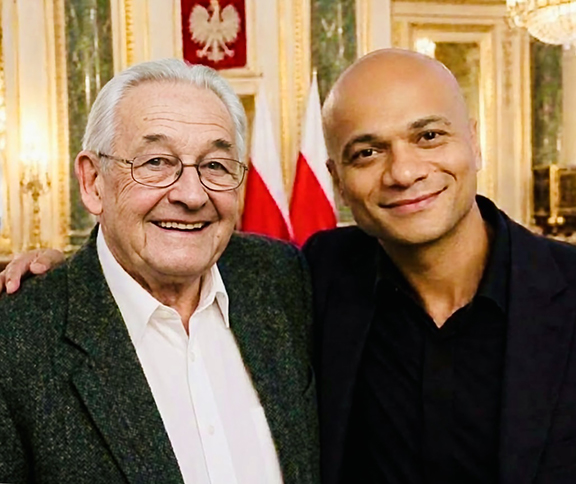
Andrzej Wajda was first a legend of Polish cinema to him, then a professor, a mentor, and ultimately a friend. Their relationship began at the Theatre Academy in Warsaw and endured for many years, even after Omar Sangare moved to the United States. What remains are handwritten letters, memories, and a lasting lesson in attentiveness to others.
On the centenary of Andrzej Wajda’s birth, and on the occasion of the 21st Austin Polish Film Festival, we explore a lesser-known side of the director and the enduring relevance of The Promised Land.
Joanna Sokołowska-Gwizdka: You described Andrzej Wajda as “a man of empathy.” Was that a deliberate reference to Man of Marble?
Omar Sangare: Yes, absolutely. Andrzej Wajda was deeply devoted to people. He had the ability to recognize an individual in the midst of a crowd, with all their dreams, frustrations, ambitions, and personal stories. For me, this was an extraordinary experience and a profound lesson: among millions of people and countless concerns, we must sharpen our vision to see the individual.
This applies not only to artistic work, developing a character, or preparing to perform before a camera or on stage, but also to everyday life.
How did your relationship begin?
I was a third-year student at the Theatre Academy in Warsaw. I learned that Professor Wajda had asked the directing students to find me and invite me to his classes.
We were working on Strindberg’s Miss Julie. Andrzej Wajda offered me the role of Jean. These were classes for young directors. The way he treated actors, communicated with them, and created an environment in which they could work demonstrated that, for him, the human being always came first.
Later, he offered you the role of Othello.
After graduating, we met again. This time, Andrzej Wajda approached me not as a professor, but as a director. He asked whether I would be interested in playing Othello at one of Warsaw’s theaters.
We talked about Shakespeare, about the individual’s distinctiveness in relation to society, and about the need to protect one’s individuality from the pressures of the world around us. These were themes very close to Wajda’s heart.
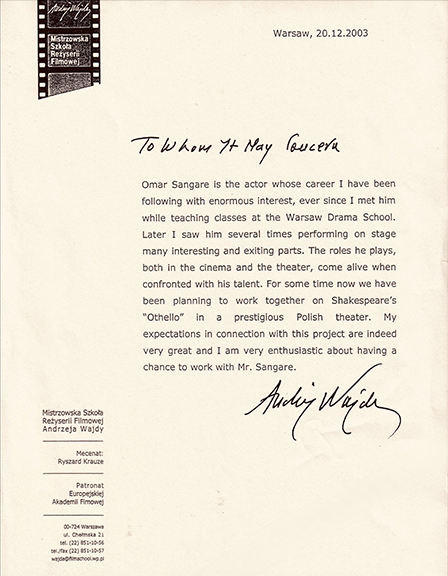
Andrzej Wajda then wrote to Stanisław Barańczak, who was translating Shakespeare’s plays, asking him to translate Othello. Barańczak undertook the task. I received a letter from him along with a typescript of the newly completed translation. He explained that it had been prepared at Andrzej Wajda’s request, as Wajda was deeply interested in our theatrical project.
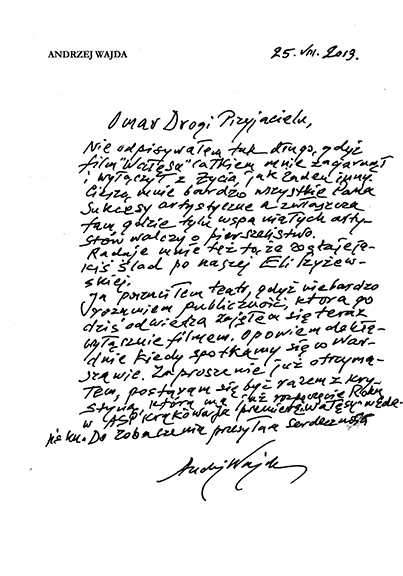
To this day, I have kept that copy, Barańczak’s letter, and many letters from Andrzej Wajda. They are like sacred relics to me, reminding me of how much I have been given in life.
What was special about Andrzej Wajda’s letters?
They were handwritten. Wajda, despite being such a busy man, found the time to sit down and write a personal letter. In doing so, he conveyed not only information, but also his attention, respect, and genuine interest in another person.
What did you correspond about over all those years?
We maintained an ongoing dialogue about our lives and the projects we were working on. Andrzej Wajda wrote about his theatrical and film projects, his work at the Stary Theatre in Kraków, and his preparations for a film about Lech Wałęsa. He described how deeply each new undertaking absorbed him, transporting him into another time and another world.
For my part, I shared my experiences in the United States, including my work at Williams College, where I have been teaching for over twenty years, and my encounters with American theater artists.
Our correspondence also influenced artistic decisions. One of its outcomes was my connection with Elżbieta Czyżewska.
What role did Andrzej Wajda play in bringing you together?
Wajda met Elżbieta Czyżewska in New York and suggested that she contact me. Elżbieta called me while I was rehearsing at the Dramatyczny Theatre in Warsaw. That conversation brought our artistic paths together in a production of Six Degrees of Separation by American playwright John Guare, a play that had already enjoyed enormous success in the United States and had been adapted into a Hollywood film.
When I later moved to America, I met John Guare himself. After Elżbieta’s death, we met at The Actors Studio in New York and began reminiscing about her. This led to the idea for a performance in which two friends remember someone who has passed away, one from a Polish perspective, the other from a New York perspective. The performance was recorded, and the recording became part of the Lincoln Center collections.
So my path to meeting one of America’s most important playwrights began with Andrzej Wajda. There were many similar stories. Wajda opened doors for people, often without even realizing how far those doors would eventually lead them. Many others were equally fortunate: Pszoniak, Olbrychski, Janda, Żebrowski, and Seweryn.
What distinguished his approach to working with actors?
Andrzej Wajda took the casting of his films and theatrical productions extremely seriously. To him, an actor was not simply someone who performed a role, but a creative collaborator. His actors brought their own histories, experiences, and personalities to the films.
Wajda would call actors, talk with them, and invite them to collaborate. He was genuinely interested in what another person had to say and what they could bring to the project.
You can also see this in documentary footage of him working on set. The camera was not a barrier between the director and the actor. On the contrary, it became a reason for them to come together.
At the Austin Polish Film Festival, we will be screening The Promised Land. The film was nominated for an Academy Award in 1976, but it never received a theatrical release in the United States. That must have been disappointing for Andrzej Wajda.
I think what mattered most to him was conveying what he and his collaborators believed was important at that particular moment. How the film would be received was of secondary importance. He understood that a work of art often has to wait years, even decades, to gain recognition, and that it may become a revelation for future generations.
And that is precisely what is happening with The Promised Land today. Many people are discovering it for the first time. I watched the film again quite recently and was deeply struck by how relevant it remains.
What do you find particularly significant about this film from the perspective of contemporary America?
The Promised Land tells the story of people lost in chaos. It asks how we can preserve friendship, respect, and humanity when success is measured in material terms and the pursuit of it leads to cruelty and indifference toward others.
What is true success? What price are we willing to pay for it? And what values must we preserve to avoid losing ourselves?
Today, we see a deeply divided American society, with people feeling lost, alienated, and often experiencing the dramatic consequences of the relentless pursuit of success. These consequences affect family, social, and personal life. And this is happening not only in the United States, but in many other countries, including present-day Poland.
You have been teaching in America for many years. What lessons from Wajda do you pass on to your students?
Above all, the conviction that art is not merely a profession. It is a way of looking at the world and at other human beings.
This applies to acting and directing, but also to solo performance, a form of theater I have been involved with for many years. I want my students to understand who we are as human beings, why we make certain decisions, and how our psychological journeys unfold throughout our lives.
I often tell them that my classes are sociology, psychology, and philosophy in practice. On stage, they can experience and examine situations they may one day encounter in their own lives.
Last semester, interest was so overwhelming that I admitted more than 200 students to my classes. It was a record number at Williams College, an American institution founded before the University of Warsaw.
I think there is something deeply meaningful about this, especially in today's chaotic times. Young people are searching for human connection. They want to understand others, and they also want to understand themselves better.
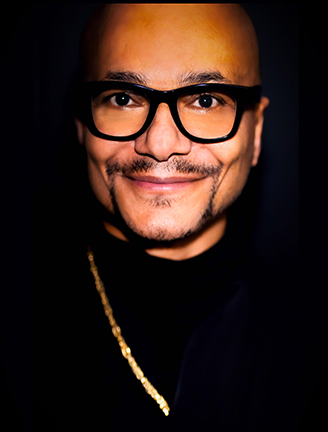
You are also the founder of United Solo, an international solo theater festival in New York. What fascinates you most about bringing together artists from around the world?
This year marks the 21st edition of United Solo. Our festival began in October and will continue through the end of November. Artists from different continents come to 42nd Street in New York. Each brings a unique story and a distinct way of seeing the world. And each performs alone on stage. In this way, we come closer to understanding individual lives.
It is a fascinating experience. All you have to do is sit in a theater seat to embark on a journey through different cultures, traditions, and human experiences.
What has stayed with you from your many years of friendship with Andrzej Wajda?
Above all, his way of looking at art and life.
I remember that even when I was in high school, Wajda's films were considered essential viewing. I watched great actors on screen. I didn't understand everything at the time, but I knew I was watching something important.
The same is true of literature. When I read Mickiewicz or Szymborska as a teenager, much of what they wrote was beyond my experience. Only as I grew older did I begin to discover deeper layers of meaning.
It is the same with Wajda's films. I return to them and continue to discover new perspectives and meanings I had not noticed before.
What was also extraordinary was that artists I had admired as a young man later became part of my own artistic projects. In Warsaw, I directed Yvonne, Princess of Burgundy, featuring Daniel Olbrychski and Barbara Wrzesińska, who had once seemed to me unattainable models of acting excellence.
Andrzej Wajda also taught me that we can look at our own lives as a screenplay we are helping to write. Every day, we create our own story. And it is up to us what we do with the opportunity to write, direct, and shape our own lives.
Interview by Joanna Sokołowska-Gwizdka
The interview took place on October 30, 2026, in connection with the centenary of Andrzej Wajda’s birth and the 21st Austin Polish Film Festival. The festival will take place November 5–8, 2026, at AFS Cinema in Austin, Texas. It will open with a screening of Andrzej Wajda’s film "The Promised Land" (1974).